Southwest

northern beardless tyrannulet

Northern Beardless Tyrannulet - its name is bigger than the bird .

Arizona and New Mexico High Points: Madera Canyon 7000 ft, Miller Canyon 8000 ft, Rustler Park and Emory Pass 8200 ft, Sandia Peak 10,678 ft.

Arizona and New Mexico Low Point: Seven flat tires in six days.

OK, now I’m getting serious.

Riding into Western Arizona was like riding into a wall of heat. In our lives, we have spent a lot of time in the outdoors, but this was a new challenge. We had to cross the desert on the interstate (Ken named his bike “A Horse With No Name” for you old time Rock ‘N” Roll fans). We devised a heat-wave strategy. We got up before light and drank cold coffee brewed the night before. We set off at first light and cycled as far as we could until midday. Then we hunkered down in the shade, if we could find it. After four days of this we coasted down a long hill to Catalina State Park on the outskirts of Tuscon. We rested there for 2 days.

Southern Arizona has many birding hot-spots, but we were there too late for most of the summer birds. Malkolm was hoping that some stragglers would still be around and that he‘d have 350 species on his bird list before leaving Arizona. With the help and advice of local birders and a fair amount of work, he achieved his goal. Henry Detwiler (Yuma) accurately gave us directions for finding a Thick Billed Kingbird and Le Conte’s Thrasher. Matt Brooks (Tuscon) told us where to look for Rufous-Winged Sparrows and Northern Beardless Tyrannulets. We met Dr George West banding hummingbirds in Madera Canyon. He advised us which trail was best for birding in the canyon, and we found an Elegant Trogon, a Greater Pewee, and a Hepatic Tanager.Tony Battiste and Mary Jo Ballator showed us where to wait for a Scott’s Oriole.  Joe Woodley found us Scaled Quail out his back door. Joe, Tony and  Rick Romea hiked with us up Miller Canyon where we saw a Williamson’s Sapsucker and two Empidomax Flycatchers (Hammond’s and Dusky) – our last chance for these two species that we had missed in the boreal forest. Then we visited Cave Creek Ranch. We relaxed in lawn chairs, waiting for a Blue-throated Hummingbird to visit the feeder. It did, and Malkolm whooped with joy - for this was his 350th bird. Tony Godfrey suggested a good place to find Olive Warblers. All we had to do was cycle up about 4000 ft on a dirt road. Tony also went owling with Malkolm (Whiskered Screech) and took us to a mesquite thicket where we saw Lawrence’s Goldfinches. He tried to get us Bendire’s Thrasher as well. Tony could hear them calling, but we were not good enough to make the identification.  Other species we were glad to see in AZ were Montezuma Quail, Gray Hawk, and Violet-crowned Hummingbird. And Malkolm was really relieved to find a Black-capped Gnatcatcher because he got really scratched up in mesquite while searching.

In Tuscon, we met with Audubon members three times. First time was for a potluck feast. Second was a birding outing in town. Third was our Saturday night show, with an impressive turn-out. We ended our time in AZ with a presentation to a large percentage of the population of Portal.

I never knew that New Mexico is mountainous. The passes are often signposted: Indian Divide elev 6940’, Emory Pass elev 8178’. I was always relieved to see one of these signs as it meant my climb was over. (The most commonly signed passes don’t denote the end of a climb. They are “Do Not” and “With Care”.)

OK, now I’m getting serious.

We did our longest daily rides of Bird Year in order to get to Albuquerque in time for our busy week there. We rode 70+ miles the first day, 80+ the next, and a whopping 98 miles the third day. A few days later, we rode one vertical mile above Albuquerque, to the top of Sandia Crest. Andy Wright guided us into Albuquerque and to the top of the mountain.  He is now an honorary member of Team Bird Year. A few days later, a cyclist from Roswell, Scott Furciniti, met us along the road, cycled with us and then treated us to hot (second) breakfast in town. As I have said before, people are very kind to us.

Cole Wolf, Raymond van Buskirk and Michael Hilchey are young birders who band and study Rosy Finches on Sandia Crest, and they gave us lots of helpful information. Jerry Oldenettel taught us how to “kick the grass” for winter sparrows. It’s a lot of fun, and no, you don’t kick any sparrows. Steve West in Carlsbad guided us to find Long Eared Owls.

In New Mexico, we met with Audubon groups in Silver City, Santa Fe and Carlsbad. Dan Shaw organized a full day of activities for us at Bosque School, as well as an evening event for young activists.  Malkolm spoke at that, alongside Dave Foreman. We also presented at the Festival of Cranes in Socorro.

We spent Thanksgiving at Bosque del Apache. After a day and a half of admiring huge flocks of cranes and geese, and seeing a rare Aplomado Falcon, the weather deteriorated. Erv Nichols, an enthusiastic volunteer, introduced us to the staff. The Refuge manager offered us a place to stay in the bunkhouse, and the volunteers fed us Thanksgiving dinner.  Next day we headed out and collided with winter. Snow was falling all around the southwest, but we managed to miss most of the snow fall. We had bitterly cold winds for one day... and headwinds for about the next 2 weeks.

We met dozens of friendly and helpful people along the way. Some of them welcomed us into their homes. Thank you to Vivian and Aleck MacKinnon, Chloe Igini, Tony Battiste, Tom Beatty Sr, Tony Godfrey and Shiela de Long, Connie Adler, Judith Nelson, Christianne Hinks, Chuck Houston, and Steve and Renee West.


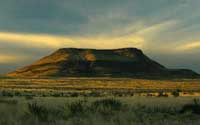
Photo from Otero Mesa by Joe Adair.

Photo of Otero Mesa (Joe Adair).

Otero Mesa is home to over 1,000 native wildlife species, including over 250 species of birds. This 1.2 million acre jewel of Chihuahuan desert grassland is threatened by fossil fuel development.

To learn more about the conservation campaign: http://www.nmwild.org/campaigns/otero-mesa/    

To learn more about the birds of Otero Mesa: http://www.oteromesa.org/birdreport.htm 
Malkolm's photo of a Rock Wren.Audubon New Mexico

(for more info about Audubon New Mexico — we are grateful for their collaboration)

The Randall Davey Audubon Center will be offering Audubon’s (and possibly the nation’s) first-ever no waste camp session this summer. They will be locking the dumpsters at the Center, making their recycling and composting bins more visible, and doing their best to produce zero waste. Audubon NM is excited about walking the talk this summer! Congratulations to Audubon NM!

Home    Our Project    Protect Birds    Sponsor Us    Arctic Refuge    Blog   Contact Us